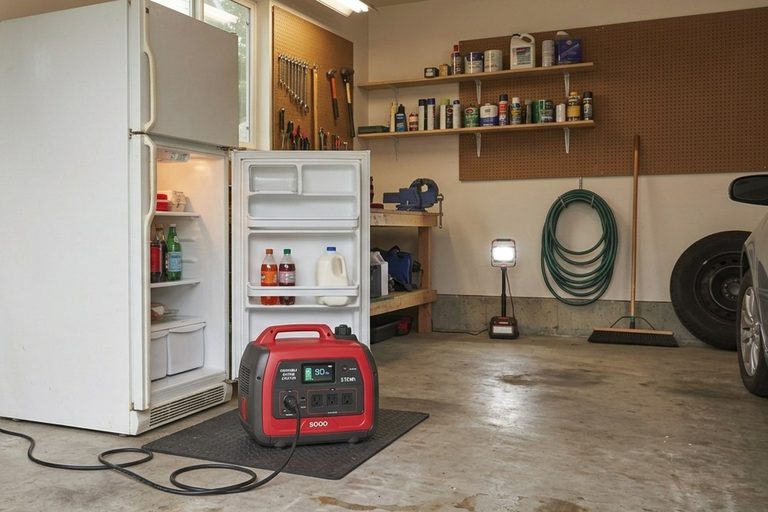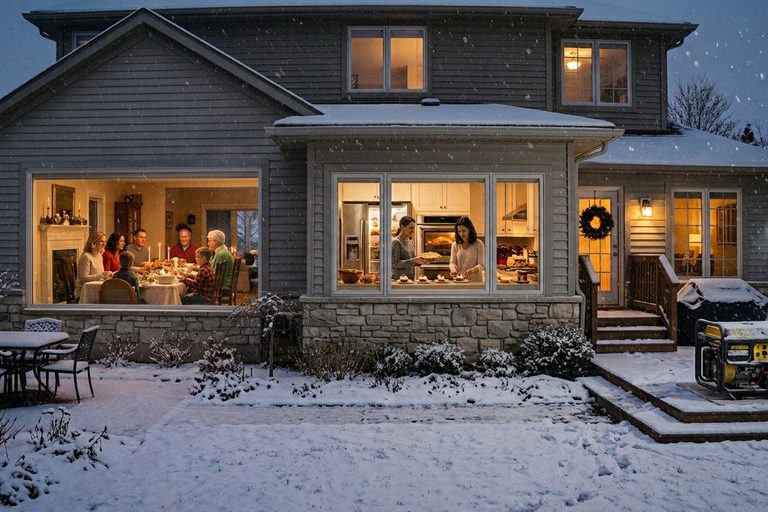
Will a Generator Run the Oven, Fridge and Slow Cookers on Thanksgiving?
Most portable generators can run the fridge and slow cookers but not the oven. Here's how to plan a full Thanksgiving meal during an outage.

Set a portable generator at least 20 feet out, aim its exhaust away from your home and your neighbor's, and keep nearby windows shut.
The lights go out on a cold, windy night and you carry the portable generator out the back door. Before you pull the cord, decide two things: where the generator sits and which way the exhaust points. Set it at least 20 feet from your house, away from every door, window and vent. Point the exhaust away from your home and from your neighbor's home too. Distance helps, but it isn't the whole answer. Air moves in ways you won't see in the dark.
The rule is simple. Run a portable generator outdoors only, never inside. Place it at least 20 feet from the house. The U.S. Consumer Product Safety Commission (CPSC) also says to point the exhaust away from your home and any other building someone could walk into.
The CDC gives the same number. It says to keep a generator outside and at least 20 feet from doors, windows and vents. Its carbon monoxide page goes a step further and says "more than 20 feet."
Local fire departments say it too. Palm Beach County Fire Rescue tells residents to keep generators at least 20 feet from windows and other openings. It says to point the exhaust away from homes, "yours AND your neighbor's."
Twenty feet is farther than most people guess. It's roughly the length of a full-size pickup and a half, which puts the generator well out into the yard, not tucked beside the back steps. Fall storms and the first ice of the season tend to knock out power when it's dark and cold. Those are exactly the nights you'll want the generator close to the house to save steps. Settle on the spot now, in daylight, so you aren't guessing during the outage.
Generator exhaust contains carbon monoxide (CO). You can't see it or smell it. It builds up in a closed space, and it can make a whole family sick while they sleep before anyone notices anything wrong.
The numbers are serious. CPSC reports that an average of nearly 100 people a year die of CO poisoning from portable generators, based on its most recent multi-year data. Across all CO sources, not just generators, the CDC counts more than 400 Americans killed each year by unintentional, non-fire CO poisoning. More than 100,000 go to an emergency room and more than 14,000 are hospitalized.
The 20-foot figure shows up again and again for a reason. CPSC, the CDC, Rutgers University and county fire departments all use it as the minimum. Treat it as a minimum, not a target. If your yard lets you go farther, go farther.
Most generator advice talks about your own house, but exhaust doesn't stop at the property line. Palm Beach County Fire Rescue tells people to point the exhaust away from their neighbor's home as well as their own. Rutgers says the same thing: keep the generator more than 20 feet from your home and your neighbor's home, including their doors, windows and open garages.
It works both ways. Palm Beach County warns that fumes from a neighbor's generator can drift over to you if your windows are open. On a street of houses built close together, where half the block runs generators after a storm, that's a real risk.
Placing a generator close to a neighbor's home isn't generally against the law. The guidance here is advice, and local noise and placement ordinances vary by city. Still, it's the neighborly thing to do, and it's simple to arrange ahead of time. Before the next outage, talk across the fence. Ask where their generator usually sits and point out where yours will go. Tell them which windows are bedrooms. If you'll be away over Thanksgiving and they might run a generator while you're gone, let them know your house will be closed up, or that a window may be cracked. The conversation takes five minutes.
Distance is the starting point, not a guarantee. A house pulls in outside air through more openings than most people think about. Generac lists common entry points for exhaust: garage doors, attic and soffit vents, basement windows, furnace vents, dryer vents, cracks in walls, and HVAC intakes.
Open windows are the most obvious way in. In Glenview, Illinois, in July 2011, NBC Chicago reported that a family ran their generator about 15 feet from the house and everyone got sick overnight. The father believed the fumes came in through a window left open for an air conditioner. They recovered after a few hours of oxygen therapy.
Even 25 feet may not be enough. A local Connecticut column described a case in Rowayton after Superstorm Sandy. A neighbor's generator exhaust sat about 25 feet from a child's first-floor bedroom window and about 4 feet lower. Once the window was opened, fumes still reached the room. The local fire chief, Ed Carlson, blamed the stack effect: an open low window can draw outside air into a house, and whatever is in that air comes with it.
In practice, keep windows on the generator side of the house closed. Aim the exhaust toward open yard, not toward any wall, and check the neighbor's side as well as your own.
Some places feel like "outside" but aren't. CPSC says never to run a portable generator in a home, garage, basement, crawlspace, shed or other enclosed space. It also rules out porches and carports. Opening doors or windows does not provide enough ventilation, and the CDC agrees: never in the home or garage, even with the doors open. A partly open garage door is a common mistake. Don't do it, even to keep the generator out of the rain.
Permanent standby generators, the kind wired in and mounted on a pad, follow a different spacing standard. Generac's summary of the fire code (NFPA 37) calls for at least 5 feet from wall openings such as operable windows, doors and vents. It also calls for 5 feet of clear space above the unit and 3 feet at the front and ends.
That 5-foot rule applies only to installed standby units built and tested for it. It does not apply to portable generators. Don't use it as a reason to pull a portable closer to the house.
Even for standby units, Generac says a generator installed to NFPA requirements "may still allow CO to enter the structure" and "may need to be installed farther" away. Local codes come first. If you're planning a standby system, follow the model's installation manual and your local code. Have a licensed electrician install it along with the transfer switch, and ask them about nearby windows and intakes, including the ones on your neighbor's house.
Do this in daylight, before the storm:
Photo by is463940 on Pixabay.
Most portable generators can run the fridge and slow cookers but not the oven. Here's how to plan a full Thanksgiving meal during an outage.
Power died with the turkey in the oven? Check its temperature, move it to a hot outdoor grill fast, and finish it safely.
Learn how to calculate how long a 1,000, 2,000 or 3,600 Wh power station will run your fridge, with a simple formula and food-safety limits.