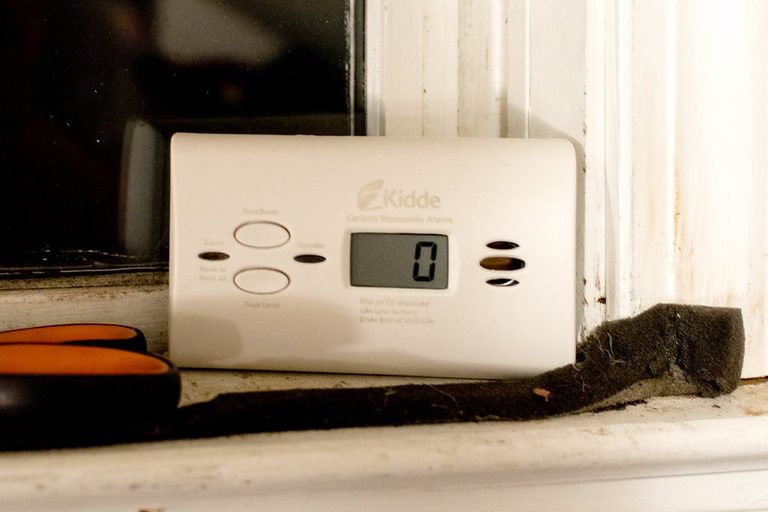
The covered porch is still inside for carbon monoxide
A covered porch counts as indoors for carbon monoxide. Learn the 20-foot rule, safe generator placement, and how to set up CO alarms.
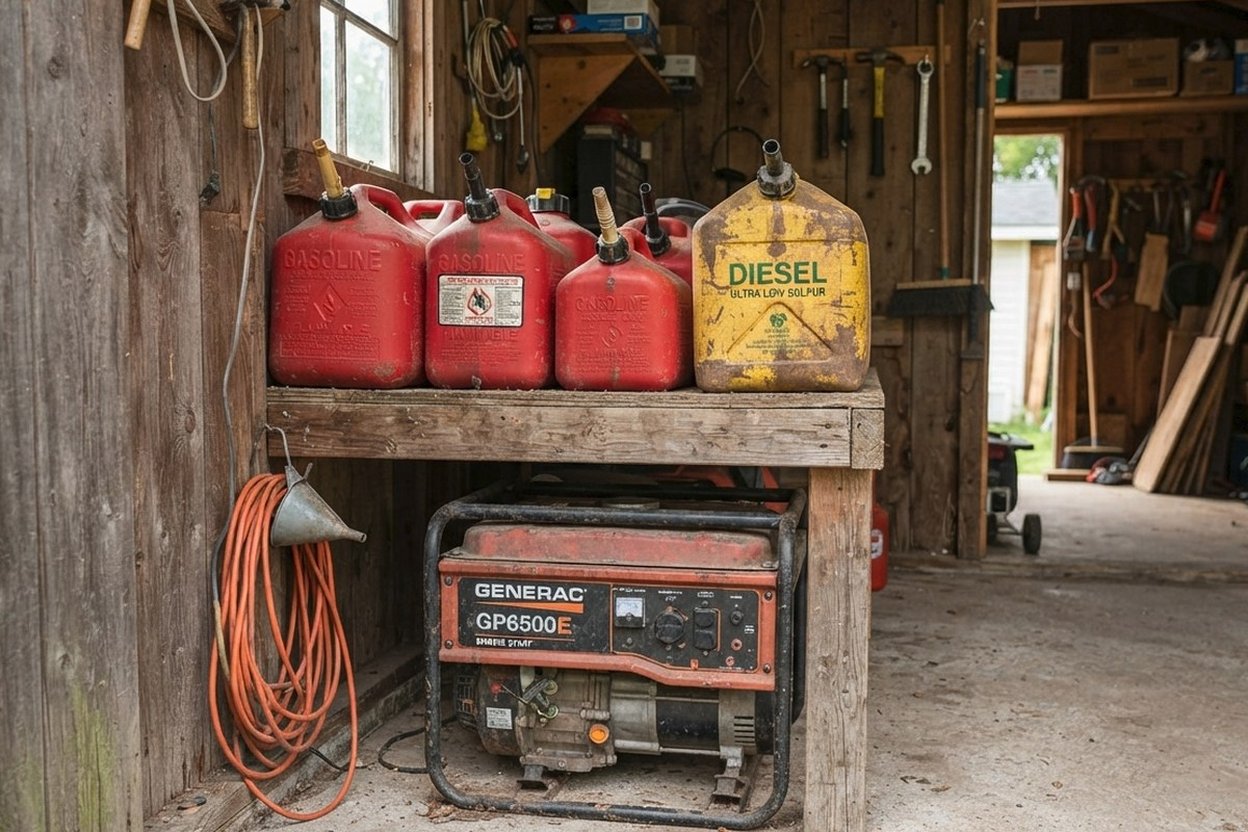
How long stored gas and diesel stay usable, what stabilizer adds, how ethanol changes things, and how to store and rotate fuel cans safely.
Plain gasoline (E10 from the pump) starts to go stale in about a month and should be used within about 3 months. Add a storage stabilizer the day you buy it and it can stay usable for up to 2 years, according to the maker of STA-BIL. Diesel holds up longer. Untreated, it's good for roughly 6 to 12 months. With a stabilizer and a biocide it can last 12 to 24 months. In both cases, how you store it matters as much as what you add to it.
Almost everyone needs this in the fall. The generator gets pulled out, you fill a few cans, and those cans sit until the first ice storm. Here's how to keep that fuel good enough to start an engine when you need it.
Gas is a blend. The lightest parts evaporate first, and those are what make a cold engine start easily. A Department of Energy study found that gasoline gets stale before ethanol's water absorption becomes a problem, and that in hot, humid storage it weathered a lot within about one month.
As gas oxidizes, it leaves gum and varnish behind. In a small engine that means a clogged carburetor jet, which is why a generator that ran fine in March surges or won't start in November.
You'll see it and smell it. Fresh gas is clear to pale. Old gas turns darker, smells sour like varnish, and can leave a sticky film on a dipstick or a rag.
Most pump gas in the U.S. is E10, meaning up to 10% ethanol. Ethanol pulls in water. Once enough water gets in (industry sources put it around 0.5% by volume), the water and ethanol drop out together and settle to the bottom of the can or tank. That's called phase separation.
The bottom layer is what a generator's fuel line draws first, and an engine won't run on it. Mixing doesn't fix it, because the gas left on top has lost its ethanol and some of its octane.
A rule of thumb you'll hear is 90 days for E10 before separation is a risk. In practice it often takes longer, and the gas usually goes stale first. Still, plan on 3 months as the limit for untreated E10.
Ethanol-free gas (sold as "rec fuel" or "marine gas" at some stations) stores better and is easier on small engines. It costs more per gallon and you won't find it everywhere. If a station near you sells it, use it for the generator.
Stabilizer slows oxidation. It can't bring stale gas back. Add it when the fuel is fresh, ideally right at the pump.
STA-BIL Storage, the most common brand, calls for 1 ounce per 2.5 gallons, so a 5-gallon can takes 2 ounces and a 16-ounce bottle treats 40 gallons. The maker says it keeps gas fresh for up to 24 months and works with ethanol and non-ethanol fuel. After you treat the fuel, run the engine about 5 minutes so treated gas fills the carburetor and lines. The bottle has its own shelf life too: 2 years after opening, or 5 years from the production date.
Treat "up to 24 months" as the best case. A sealed can kept in a cool shed will reach it. A vented can on a sunny porch won't.
Diesel doesn't have gasoline's light ends to lose, so it stays usable longer. Untreated diesel is typically good for 6 to 12 months, and it starts slowly breaking down within the first month even in a clean, sealed container.
Its main enemy is microbes. Bacteria and fungus grow where water meets fuel at the bottom of a tank. Today's ultra-low-sulfur diesel is more prone to this than the old high-sulfur fuel. You'll know it's happening when you see dark slime, a cloudy layer at the bottom, or filters that keep plugging.
For storage longer than a few months, treat diesel with a stabilizer (slows oxidation) and a biocide (kills the growth). Fuel suppliers recommend re-dosing the biocide about every 6 months if the fuel sits a long time. Treated diesel kept near 70°F can last 18 to 24 months.
Use cans built for fuel and labeled to a standard (DOT, ASTM, UL or NFPA 30). Milk jugs, glass jars and old bleach bottles don't count.
The colors aren't decoration. Red is gasoline, yellow is diesel, blue is kerosene. If you run a gas generator and a diesel tractor, buy the matching colors so nobody grabs the wrong can at 2 a.m. by headlamp.
Where the cans live:
This depends on where you live. Fire codes are adopted and amended locally, so the limit in one town can differ from the next town over.
For a sense of typical numbers, Lehi, Utah's fire department sets these residential limits:
Many towns use limits close to these, but plenty don't. Your HOA, lease or homeowner's policy may be stricter too. Check your local fire department's rules before you build a 20-can stockpile.
Most gas can fires start at the pump or in the garage, not in storage. The National Park Service's fire guidance and fuel-safety sources agree on these steps:
Stored fuel only helps if it's still good when the power goes out. The easiest way is to use it and replace it on a schedule.
That depends on what you run and for how long. A portable generator running a fridge, furnace blower and some lights can burn through a 5-gallon can in under a day. We do that math in Generator Fuel: How Much for a Day. Size the stockpile to your generator and your local storage limit, then rotate it so it never gets older than you planned.
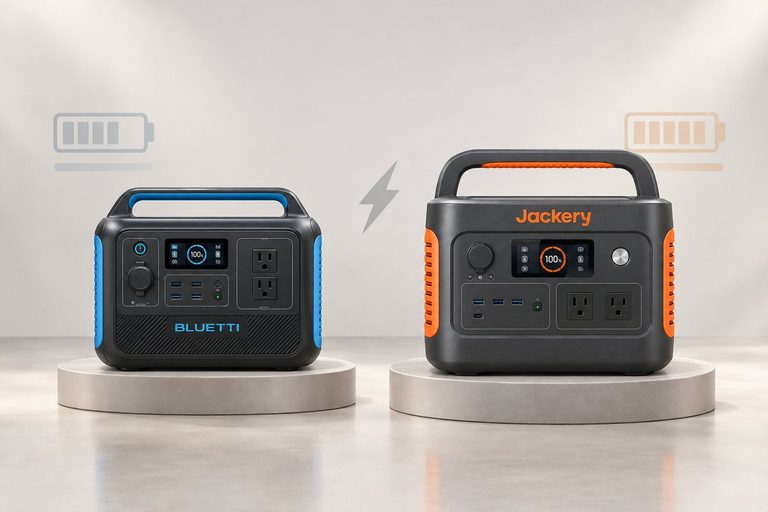
If the storage limits or the rotation are more hassle than you want, a portable power station needs no fuel at all and can handle the small loads.
A covered porch counts as indoors for carbon monoxide. Learn the 20-foot rule, safe generator placement, and how to set up CO alarms.
Check that every floor and sleeping area has a battery-backup CO alarm, placed and tested, before the first winter power outage.
Bluetti Elite 100 vs. Jackery Explorer 1000 compared on runtime, solar charging, and price, with a clear pick for keeping a home running through an outage.